SA-SE lab conducts research to address human-driven challenges in aquatic ecosystems, combining fieldwork, advanced sensing technologies, and computational modeling. The lab advances understanding of water-quality processes across systems such as streams, ponds, lakes, and agricultural landscapes while developing practical, science-based engineering solutions. Its work is highly collaborative and community-driven, engaging stakeholders to co-design sustainable, real-world ecological solutions.
Cyanobacterial Harmful Algal Blooms
Cyanobacterial harmful algal blooms (CyanoHABs) pose significant risks to humans, livestock, agriculture, wildlife, and ecosystems. Understanding and mitigating these impacts is a central focus of the research team. The group investigates CyanoHABs processes across multiple spatial and temporal scales by integrating diverse data sources, including in situ measurements, flow cytometry, sensor networks, drone-based observations, microbial diversity analyses, and predictive modeling (e.g., Machine Learning, Water Quality Analysis Simulation Program, Statistical Methods). A key objective is the development of decision-support tools and technologies that provide early warning systems for CyanoHABs. In parallel, the team evaluates and advances a range of sensing platforms to enhance the detection and monitoring of cyanotoxins.
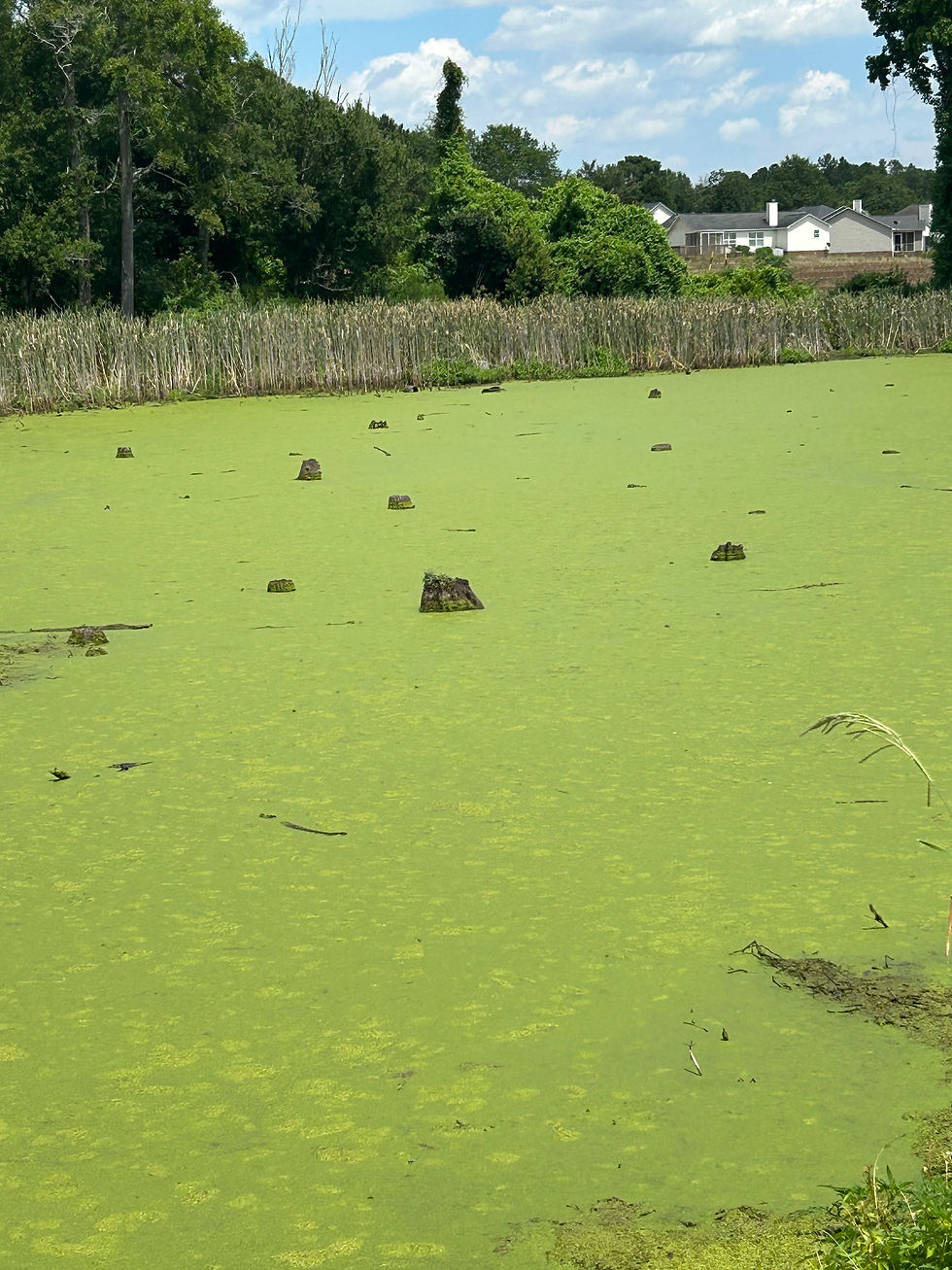


A major research emphasis is identifying the precise ecological and watershed conditions that drive aquatic systems to transition from benign to harmful, and ultimately to toxin-producing blooms. These conditions include land use characteristics, agricultural and urban runoff, connectivity between terrestrial and aquatic systems, nutrient dynamics, temperature, light availability, hydrodynamics, microbial diversity, and biotic interactions. Understanding how these ecological and watershed drivers interact is critical for determining how CyanoHABs impact aquatic organisms, food webs, human health, agricultural systems and overall ecosystem health. An understanding of these interacting processes will aid in the development of ecologically driven engineering solutions to manage them. While microcystin remains a primary toxin of interest, the group is also interested in studying other algal toxins and examining processes such as toxin aerosolization, which may extend risks beyond aquatic environments and into surrounding communities. Research results are communicated through Extension workshops.
Stream Dynamics and Monitoring


Streams act as conduits, transporting nutrients and connecting land with the waters that fuel CyanoHABs in downstream lentic systems. Lower-order streams, in particular, are increasingly impacted by human activities and climate-related pressures. Many of these streams exhibit severe erosion and ecological degradation, making it essential to understand their behavior in order to design effective stream improvement strategies. South Carolina is projected to experience significant population growth, reaching nearly 6 million by 2030. This growth, along with a surge in industrial development over the past few years, places additional stress on aquatic ecosystems. In response, my research team is actively studying streams to better understand their role in water quality, biogeochemical processes, and the development of CyanoHABs.
We use a combination of field studies and advanced technologies, including high-frequency environmental sensors (both contact and non-contact), to monitor and analyze stream conditions. The team also experiments with post-processing algorithms to clean high-frequency data streams and continually seeks faster, more effective methods to improve data quality, enabling quicker, more informed decision-making and the development of economically viable solutions.
Stormwater Management
Urban stormwater management is critical for mitigating urban runoff, reducing local flooding, and protecting water quality in downstream aquatic systems. To address these emerging challenges, the team investigates ecohydrological processes within stormwater best management practices, particularly bioretention cells and stormwater ponds. The group is especially interested in understanding how system age influences ecological processes in urban BMPs, how these systems can be leveraged beyond traditional stormwater management (e.g., for urban agriculture and human health benefits), and how to effectively engage citizens in the maintenance and stewardship of stormwater infrastructure. The team’s philosophy is to apply knowledge across systems, recognizing that insights gained from urban BMPs can inform rural applications and vice versa.


By studying both agricultural and urban environments, the team transfers effective practices between contexts in a two-way learning process. For example, ponds are relevant to both systems; while urban areas have more recent experience with constructed ponds, agricultural systems also offer long-established practices that can inform urban design, operation, and maintenance. The team scours for processes that are transferable to similar systems. Datasets and results generated by the team also aim to support the development of MS4 policies through research-driven insights.
Agricultural Management Practices


Agricultural best management practices are critical to the success of agricultural sustainability and improvement of water quality in aquatic systems. The research team investigates the impact of innovative agricultural practices such as silvopasture systems on water quality. The team gathers high-frequency hydrologic data to inform models and answer questions about silvopasture systems and land use scenarios to improve downstream water quality. Research findings are shared with farmers and producers to help them adopt silvopasture systems in South Carolina through Extension-led workshops, a practice that has received increasing attention from growers.